Friday, May 2, 2008

Pale Male and Lola - nest failure (again)


It's May, and by now the Red-tailed Hawk watchers are usually eagerly anticipating the mid-May fledging of this year's juveniles. Instead we have a New York Times piece on the failure of the classical Central Park Red-tailed Hawk nest for the fourth year in succession. It's difficult to say where the problem lies here - the nest disturbance in the winter of 2004/5, or the fact that Pale Male is now 17 or 18 years old - at the upper limit of wild Red-tailed Hawk life-expectancy. The current female (Lola) is considerably younger.

Marie Winn's page is usually the best place to go for information on that pair of hawks, if you're interested in more.

Spring migration - Princeton - May 2nd

Overnight rain combined with a southerly wind raised the prospects of migrant dropouts, and before I even got into Princeton there'd already been mention of them in a couple of places in NJ. The road towards the water facility at the Institute Woods had a couple of trees with many warblers in them - most of them Yellow-rumped Warblers. Quite a few singing species including multiple Black-throated Green Warblers and Blue-winged Warblers. I heard and tracked down a Blackburnian Warbler, which together with Black-throated Blue Warbler were new birds for the year. Overall, however, diversity wasn't that high although I did make it to 10 warbler species in about 1/4 of the time it took me the previous day.

Twenty minutes later, by 10am, these same trees were empty and the flock had moved on.

Migrant list:
Warbling Vireo
Blue-headed Vireo
Red-breasted Nuthatch
House Wren
Blue-gray Gnatcatcher
Gray Catbird
Blue-winged Warbler (multiple)
Northern Parula
Yellow Warbler
Black-throated Blue Warbler
Yellow-rumped Warbler
Black-throated Green Warbler
Blackburnian Warbler
Black-and-white Warbler
Ovenbird
Common Yellowthroat
Rose-breasted Grosbeak
Baltimore Oriole
Purple Finch

Spring migration - Central Park - May 1st

After winter trips to Florida (Feb) and Texas (April 10-18th) I had spring migration almost backwards, seeing all sorts of migrant warblers/orioles/tanagers before they ever turn up in the New York area. But after recovering from the TX trip I made it into the park on April 26th (Louisiana Waterthrush was a nice find) and on May 1st.

I usually think of the first "big" day in the park as May 5th, but apart from a slow start on the west side - where a male Purple Finch was singing - there were decent numbers of warblers in the Ramble. I managed to see 10 species which is acceptable, but not epic, in spring when I'm carrying the camera. The warblers were mostly the usual suspects - best birds for the day were the Purple Finch, Eastern Kingbird, and an exceptionally drab Pine Warbler which was rather gray except for a little green on the crown.

Migrant list:

Chimney Swift
Great Crested Flycatcher
Eastern Kingbird
Blue-headed Vireo
Warbling Vireo
Red-breasted Nuthatch
House Wren
Ruby-crowned Kinglet
Hermit Thrush
Gray Catbird
Cedar Waxwing
Nashville Warbler
Northern Parula
Yellow-rumped Warbler
Black-throated Green Warbler
Pine Warbler
Palm Warbler
Black-and-white Warbler
American Redstart
Ovenbird
Northern Waterthrush
Eastern Towhee
Rose-breasted Grosbeak
Baltimore Oriole
Purple Finch

Saturday, April 19, 2008

Out of area - Texas trip - April 10th-18th

Just made it back from a very productive trip to Texas. Starting off in San Antonio the route led through the hill country, down to the Rio Grande Valley where I spent most of the time, then back up to the coastal bend before flying out of San Antonio.

Here's the trip report for this April 2008 Texas trip (under edit) .

Experiencing a remarkable string of luck, I found life birds on each of the first five days: Black-capped Vireo, White-throated Robin, Red-billed Pigeon, Hook-billed Kite, White-collared Seedeater, Ferruginous Pygmy-Owl, Groove-billed Ani and Aplomado Falcon.

I'm sure the mosquito bites will go away eventually.

Monday, March 31, 2008

Sapsucker-assisted vagrancy


In the late half of this winter we've seen two noteworthy NYC vagrants - the Union Square Scott's Oriole and the Central Park Western Tanager - help their survival prospects by taking advantage of a less conventional food source of plant sap. Both the Oriole and Tanager have been seen drinking from sapsucker holes. Both of these sites happened to be on Viburnam bushes - an exotic hardy evergreen shrub that is present on both of these city parks. Later in the winter the Scott's Oriole was re-found in Thompkins Square Park doing exactly the same thing - drinking sap from Sapsucker holes in Viburnam.

Last winter an almost-overwintering Cape May Warbler in Riverside Park in Manhattan was seen drinking sap from Sapsucker holes, although these were probably from more native trees than Viburnam shrubs. Exploitation of sapsucker holes by Cape Mays is not an uncommon thing to observe in the Pinetum region of Central Park in late fall or early winter.

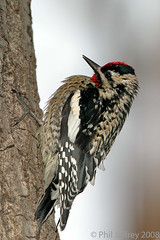
Shai Mitra, via the NYSBirds-L list made the observation that the numbers of overwintering Yellow-bellied Sapsuckers have been greater in recent years. Unfortunately I can't locate a reference for that observation. The BNA account for this species illustrates that it has a wide wintering range, with NYC being at the extreme north-eastern edge of it. It remains to be seen what influence non-native plants have on this range, because the Sapsucker doesn't appear to be all that picky over which plant to use. So a lot of unanswered questions. Certainly vagrants aren't obliged to exploit Sapsuckers - the 2006/7 Western Tanager in NJ was eating Juniper berries - but perhaps it indicates that the vagrants or out-of-seasonal rarities that we observe are the ones that are most resourceful in exploiting local food sources. Memorably the Scott's Oriole may have chosen to hang around the small corner of Union Square Park because the fruit offerings at the Ghandi statue offered it a supply of palatable food - it's a nectar drinker during the summer but eats fruit on the wintering grounds in Mexico.

Monday, January 28, 2008

Scott's Oriole in Union Square Park (NYC)


I went into NYC early on Monday morning to track down the first winter Scott's Oriole that was being seen in Union Square Park, of all places. True to form the bird was seen quite easily - perching over my head in a tree pre-sunrise and returning to the small garden in the southwest corner of the park a couple of times to pose in the sunlight. This is potentially a first NY State record for this species. More pictures with text here and a fuller collection on my gallery page for this species.

Sunday, January 20, 2008

Catskills boreal invasives (NY)


A brief foray into the southern edge of the Catskills in search of winter boreals netted some excellent looks at Pine Grosbeak in Grahamsville but unfortunately the civilized start time led to us missing feeder birds like Common Redpoll. The day was frigid (low 20's at most) with a brisk wind. So a visit to Shawangunk NWR near Wallkill in Ulster County was especially invigorating while scanning the fields for Short-eared Owl. While developing the early stages of frostbite we did see 4 Rough-legged Hawks including one dark morph and one that looked more intermediate than pale morph. That and several Northern Harriers dominated the field and we did not manage to wait out full darkness before retreating to the car to thaw out.

Thursday, November 22, 2007

Pink-footed and Barnacle Geese in Montauk (NY)


After the Masked and Muscovy Ducks in Texas in November 2007, it seemed only natural to do another crazed road trip to go find the the Pink-footed and Barnacle Geese at the Deep Hollow Ranch in Theodore Roosevelt State Park in Montauk (NY). I saw the Barnacle Goose in the first 30 seconds, but the Pink-footed Goose took more effort - the reward for hiking the trail up the east side of the pasture was that I ran into 25 Red Crossbills in a mobile and vocal flock, and TWO Western Kingbirds perched together on a wire at the northern end of the pasture. The day was remarkably balmy. Both geese were ultimately quite cooperative. There are more pictures at PFGU_2007.html. These were the first Western Kingbirds I've seen in NY state, although they are an annual vagrant - I just haven't ever bothered to "chase" them. I still remain cynical about Barnacle Geese on Long Island, although it's telling that there's another Barnacle Goose at Cape May right now. In a bit of inconsistency, Pink-footed Goose is in my USA list from the PA bird in 2005, but Barnacle Goose is still not included and I really don't want to make it USA #600.


Saturday, September 8, 2007

Connecticut Warblers in Central Park (NYC)


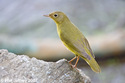
This Connecticut Warbler turned up in Central Park on Sept 8th 2007, found by Tony Lance and seen by many (click on icon to see pics). The bird lingered near Hernshead in what was at times a surreal location just behind an amplified guitar player who was "entertaining" an audience on the west shore of The Lake. Apparently oblivious to all the fuss, the Connecticut persisted until late in the day but was not found on subseqent days. This was one of a series of Connecticut Warblers that were to show up in Central Park that fall, including another exceptionally tame one up at Sparrow Ridge (Sept 18-20th) and a more elusive one at Summit Rock (Sept 23rd).